You back out of a tight parking spot with the wheel cranked to one side, and your Sonata clicks sharply from a front wheel, faster as the car picks up speed. Once the wheels straighten, the noise is gone. A worn outer CV joint clicks in tight turns like this, loudest with the steering near full lock. Inside that wheel, you may find a ring of dark grease splashed across the rim.
When a boot splits, that ring is the earlier sign: grease escapes first, and the click comes later, once road grit has worn the joint inside. For your Sonata, the order of those two signs matters for the repair. By the time the click starts, the joint has already worn inside, and that wear sets what we have to replace.
A Click at Full Lock
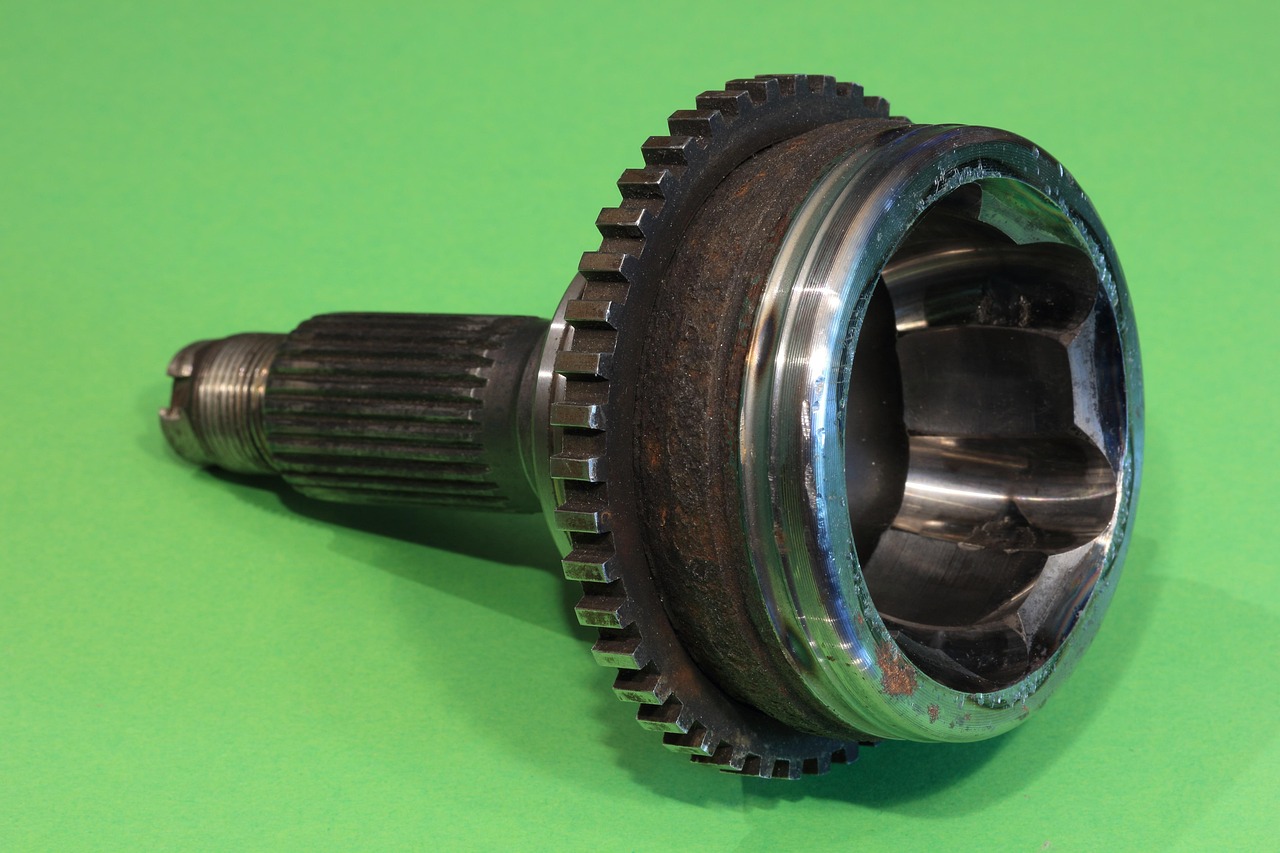
Every US Sonata drives its front wheels through two front axles, each with a CV joint at each end. A CV joint, short for constant-velocity joint, is the flexible coupling that lets the axle keep turning the wheel while the wheel steers and the suspension moves. The outer joint, at the wheel end, does the most bending because it follows the steering. At the transmission end, the inner joint mostly slides in and out as the suspension travels. Near full lock, the outer joint bends as far as it goes, and the worn balls and races inside it have the most room to knock. Turn the wheel back to center and the bend eases, so the click fades with it.
A Ring of Grease Inside the Wheel
Each joint lives inside a rubber boot, a pleated cover clamped over it that holds the grease in and keeps dirt out. The boot flexes every time the wheel steers, and over time the rubber cracks or splits along a pleat. Once it splits, the axle spinning at road speed throws grease outward in a ring, coating the inside of the wheel and the parts near it. You may notice it as a dark, sticky spray on the back of the rim or a spatter on the suspension behind it. With the boot open, the joint loses its grease and takes in road grit and water, and that grit wears the balls and the races they run in. Wear opens up clearance inside the joint, and that clearance is what you hear as the click.
A Shudder When You Accelerate
Inner joints fail with a different sign. A worn inner joint shows up as a vibration under acceleration that grows stronger the harder you accelerate. You feel it through the floor and the seat as you pull away from a light, and it settles when you lift off the pedal. Steering has no part in it. That is how it differs from the outer joint's click. Wheel bearings, tires and suspension parts can make similar noises and vibrations. We check each boot for splits and thrown grease and each joint for play.
What the Repair Involves
A clicking joint has worn inside, and fresh grease will not bring back the metal it lost. That is why we replace the complete axle assembly, with both joints and new boots. Driving on a badly worn joint risks the joint separating, which leaves that wheel without drive. Booking when you first hear the click keeps the repair ahead of that stage.
With the axle out, the hub bearing and the tie-rod end are in reach. The hub bearing carries the wheel and lets it spin, and the tie-rod end links the steering to the knuckle the axle passes through. We inspect both while the axle is out, and we base the recommendation on what we find.
Booking the Sonata Axle Repair From Oakland
On your Sonata, we replace the worn axle as a complete assembly, with new joints and fresh boots at both ends. You also hear what we found on the hub bearing and tie-rod end we inspected while the axle was out. Call Precision Auto Care in San Leandro at (510) 351-8211 to book the axle repair.